
Product Design
Tabby Bank
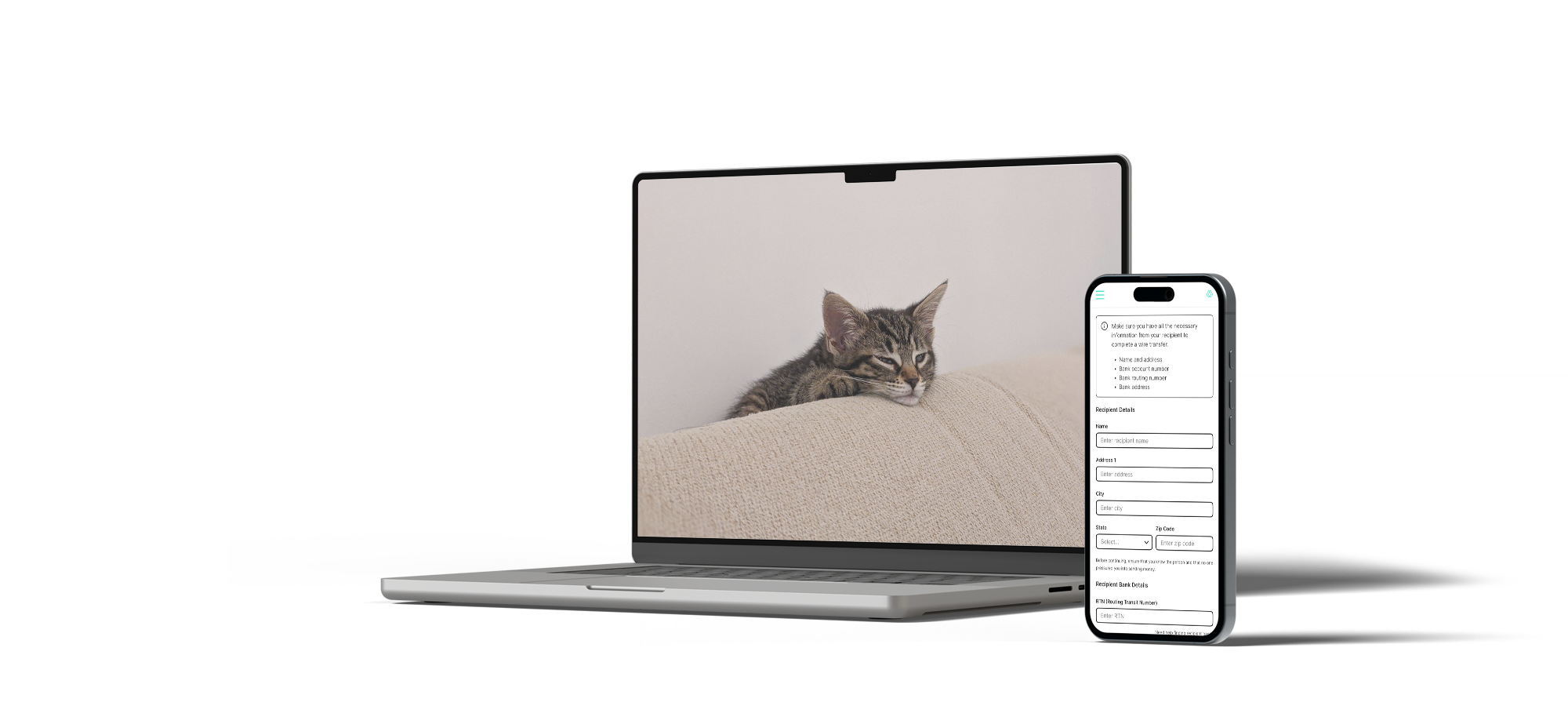
A project with the goal of simplifying the wire transfer process and providing that power to the end user.
ROLE
Product Designer
TOOLS
Adobe CC
Figma
TIMEFRAME
March 2022 - May 2023
TEAM
Design Lead
Visual Designer
UX Designer
Wire transfers are often considered antiquated in modern banking, but are nonetheless an important cornerstone for transferring large amounts of money. Businesses and individuals still rely on wires for high-value, time-sensitive transactions, such as vehicles and real estate. However, the current assortment of banks in the North American market still requires people to go into banks or make lengthy phone calls to complete the process. These workflows are shaped by legacy systems, strict compliance requirements, and risk-averse operational patterns that prioritize control over usability.
This project examines how existing banking patterns can be reevaluated and redesigned to provide a safer, more transparent, self-service wire transfer experience - one that aligns with how customers expect digital banking to function today.
UNDERSTANDING WIRES
Our goal is to create a best-in-class, self-service wire transfer solution. To do so, it was important to leverage key pain points and the use case for different transfer methods for our users. It was essential to understand how banking customers from various socioeconomic backgrounds and geographical locations utilize transfers, and identify what is most important to them to develop a framework that reaches as many customers as possible.
THE APPROACH
To create a wire transfer flow, our team used a Design Thinking approach to ideate, prototype, test, and refine future state experiences. We conducted interviews and design workshops with key stakeholders to understand the required fields that needed to be filled out, and to ensure that all requirements were met from a legal and business perspective.
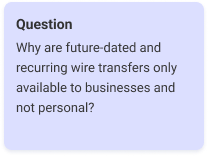

REQUIREMENTS
The project was to be done for both the mobile app and browser. This includes different browser breakpoints as well. The self-service wire transfer should be a guided experience while helping customers choose the right product to transfer money. It needs to be secure and quick. This point is especially important because its purpose is to make it faster and easier than calling or going into the bank. No current self-service option for retail customers exists in the region, but it doesn't mean that we shouldn't strive to create the best product in the market.
INITIAL PLANNING
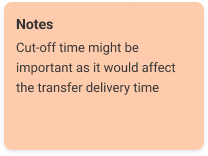
Going into the project, we first needed to map out the type of information that is required to complete a wire transfer. Since we had little to work with, we did a competitive analysis of transfer services offered by different banks in North America and figured out the following:
- Wire transfer refers to a bank-to-bank transfer, as opposed to between accounts like e-transfer, or Venmo in the U.S
- Different banks have different features associated with the same transfer method
- Some transfer methods are country-specific, even if the bank operates in multiple countries
- U.S. does not use e-transfer but instead has Zelle
RESEARCH
After researching five Canadian banks and three U.S. banks, we narrowed down on each bank's wire transfer capabilities and used the following metrics to give us an overview of where Tabby Bank sits against the others:
- Outgoing and incoming transfer fee
- Transfer time
- Wire transfer service method
- Reach; available transfer countries, etc.
- Minimum and maximum transfer amount
- Alternative transfer methods that compete with wire transfers
Wire Transfer Capability Analysis (Sample Data)

INDIRECT COMPETITION
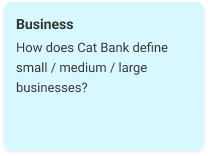
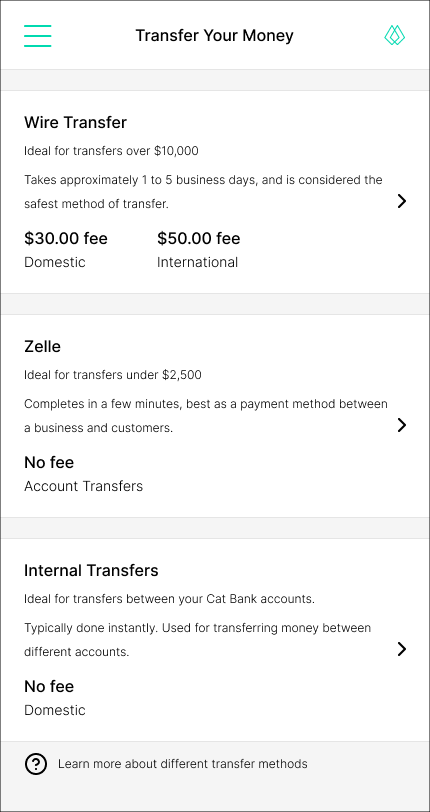
After aggregating the data to determine each bank's competitive advantage, we wanted to look at transfer methods that different services (not just banks) offer that the core function of sending money. For example, if e-transfers are free, then why would customers pay $30-$50 for a transfer? Global Transfers allow users to send up to $50,000 and often only cost $1 to $5 per transaction. This research was not only useful in developing Tabby Bank's differentiator, but also in learning how several companies would approach a transfer flow, and how users would transfer money from start to finish.
Banking Transfer Flow Observations (North America)
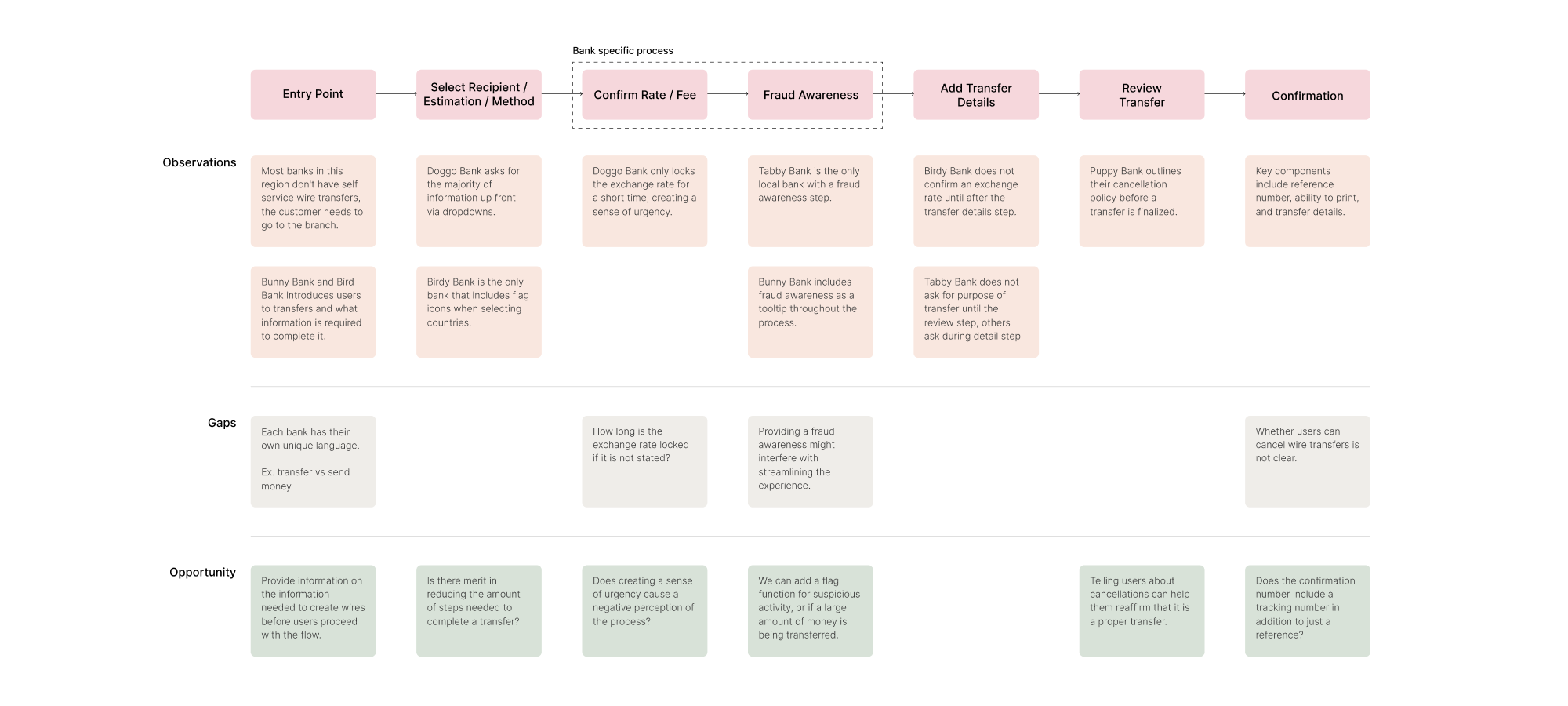
UNDERSTANDING THE GAP
After creating a theoretical transfer flow, I wanted to know how we could leverage the gaps present in different bank transfers and implement those as features for Tabby Bank. Since we were so early in the process, we could use the ideal state and break it down into multiple MVPs to eventually add everything we wanted to. Before we began building the wireframes, we presented a list of recommendations to stakeholders based on our analysis, which included:
- Fraud prevention, including warnings and a built-in prevention system that can detect fraudulent transfers automatically
- The ability to schedule transfers ahead of time, as well as cancel within a small window of time
- Notes; where customers can add notes to find specific transfers and create nicknames for contacts
USER INTERVIEWS
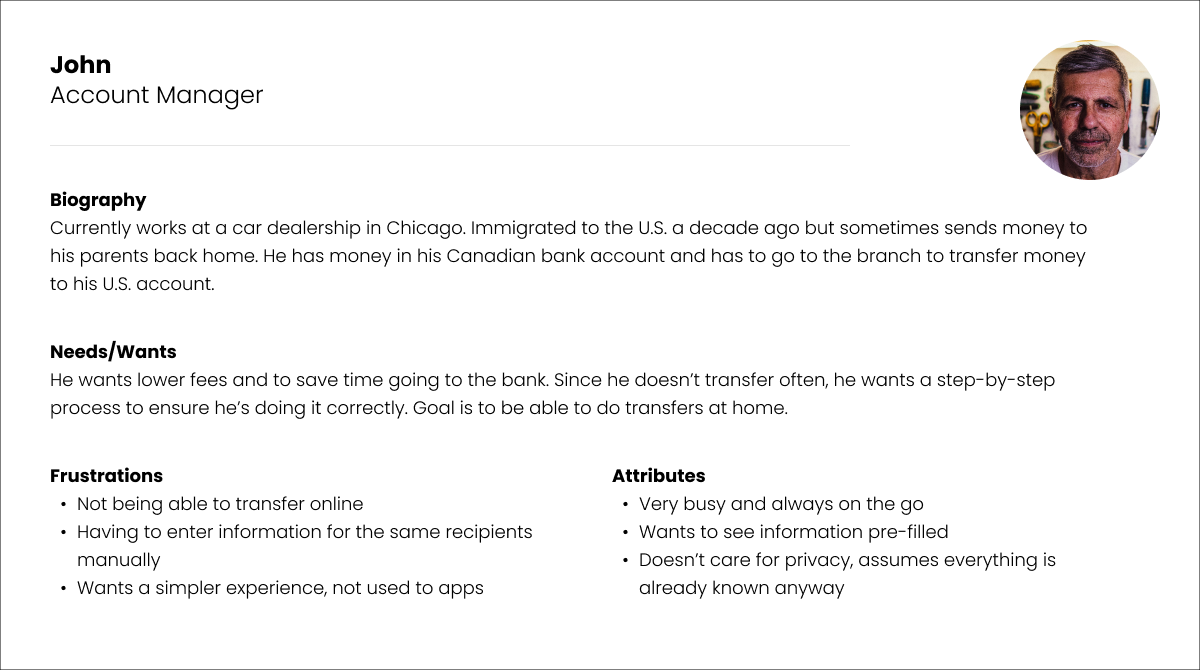
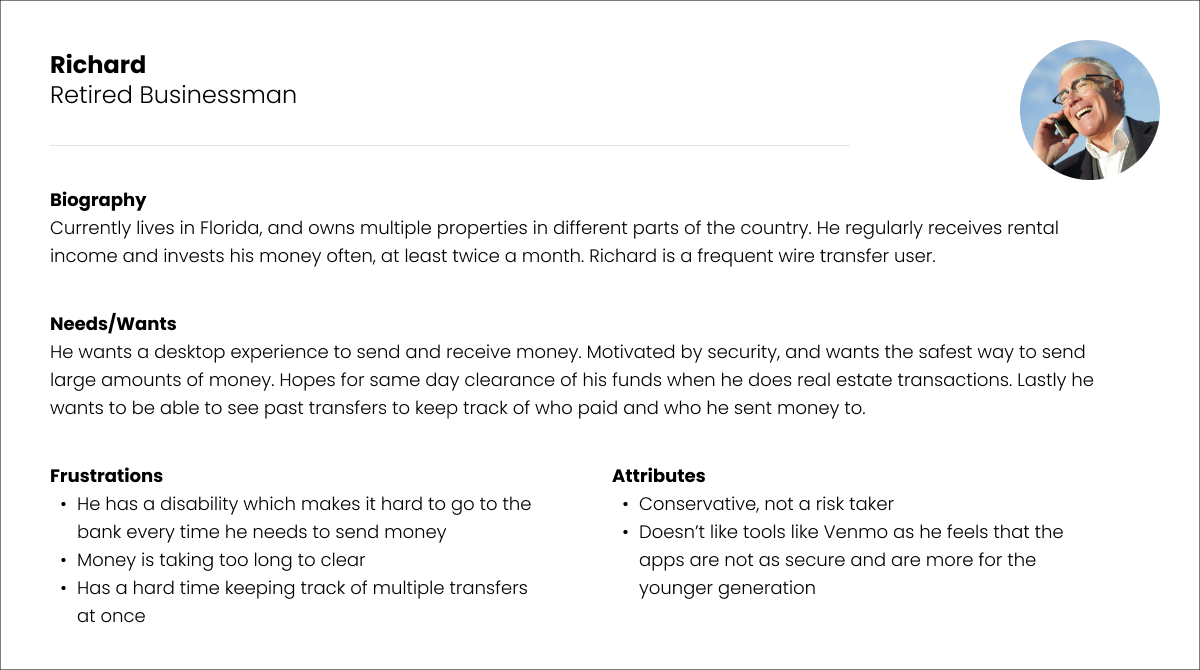
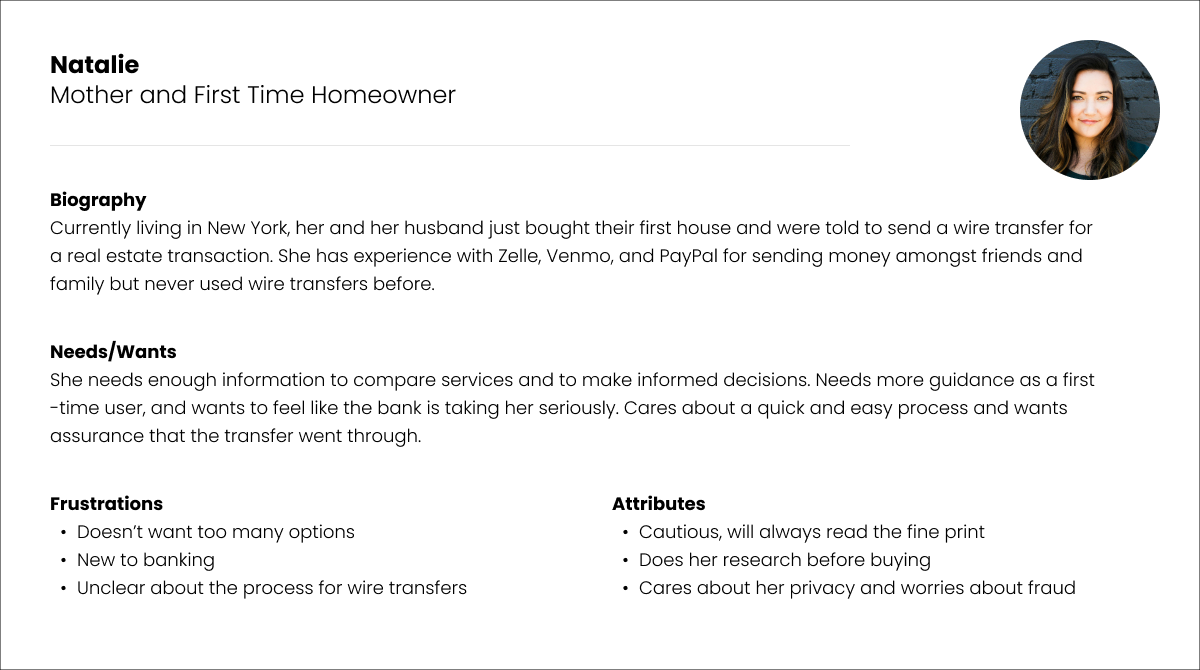
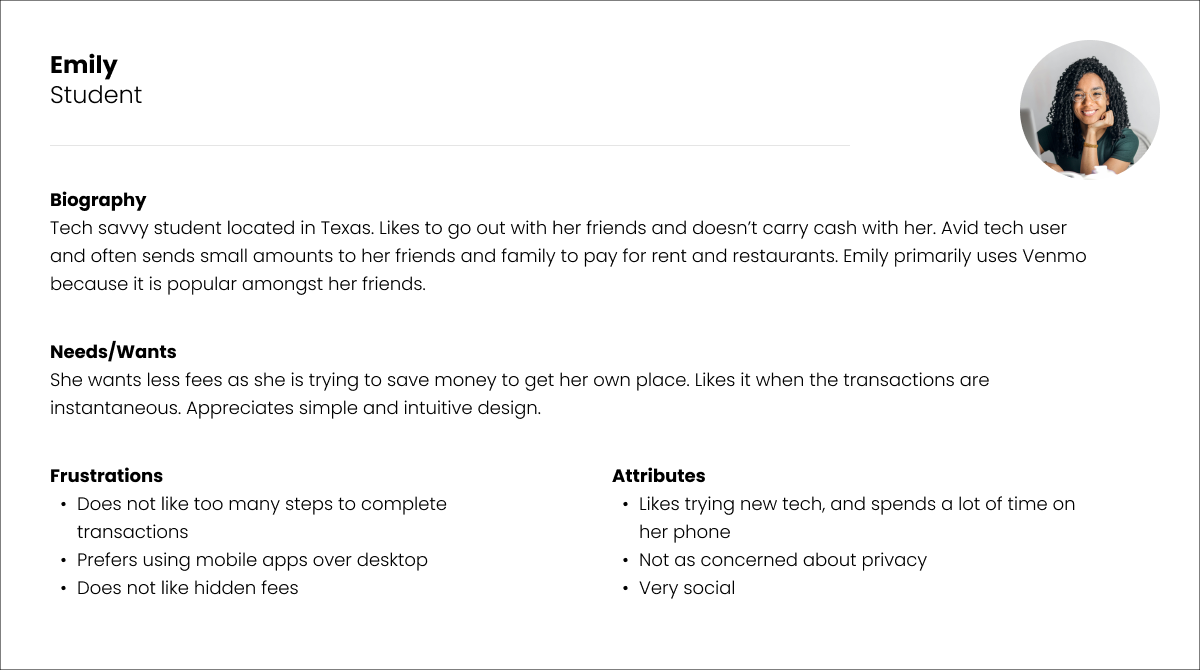
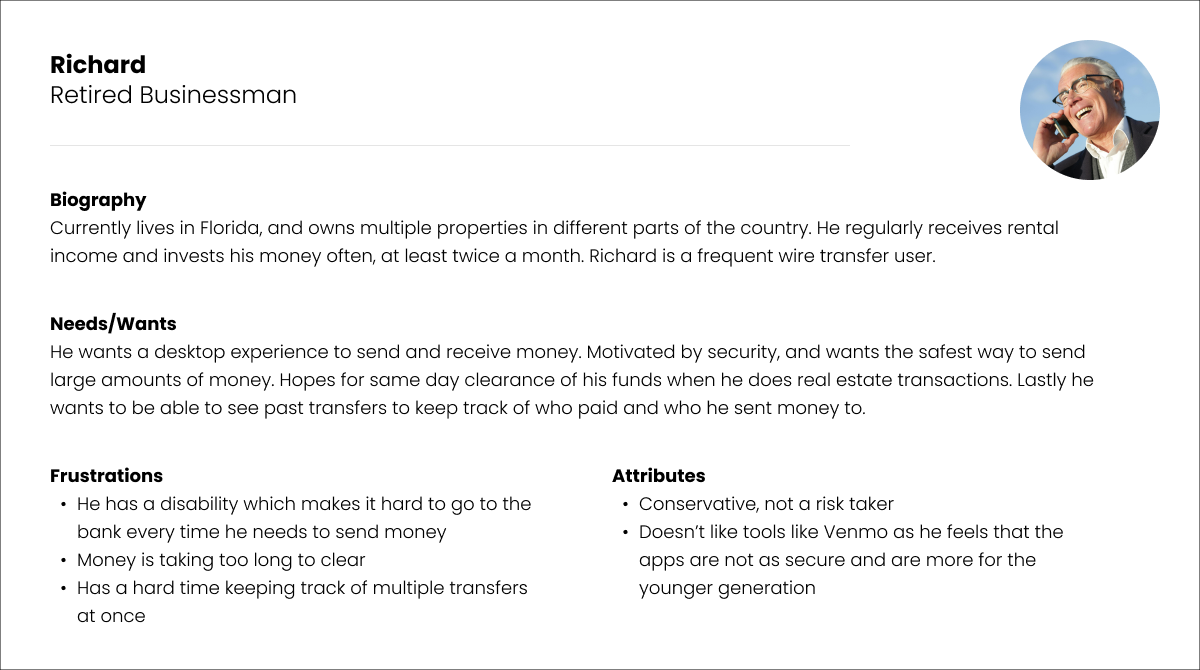
While designs were being drafted, nine users were interviewed during our preliminary test, including three employees at Tabby Bank. Users were chosen under the condition that they had conducted bank wire transfers in the past 18 months. All users interviewed are based in the U.S. The goal of this interview is to understand their experience with wire transfers as well as their usage patterns with other available transfer methods, including Venmo, Zelle, and PayPal.
A Forrester Research report was also conducted to learn about the typical wire transfer demographic and their behaviors.
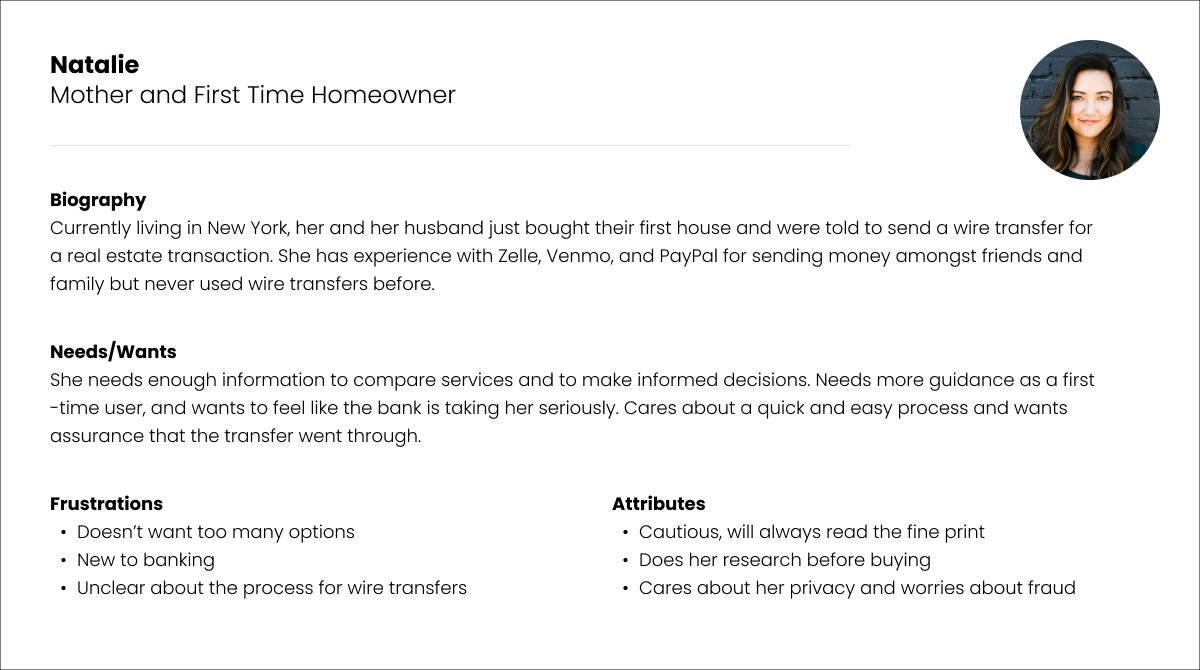
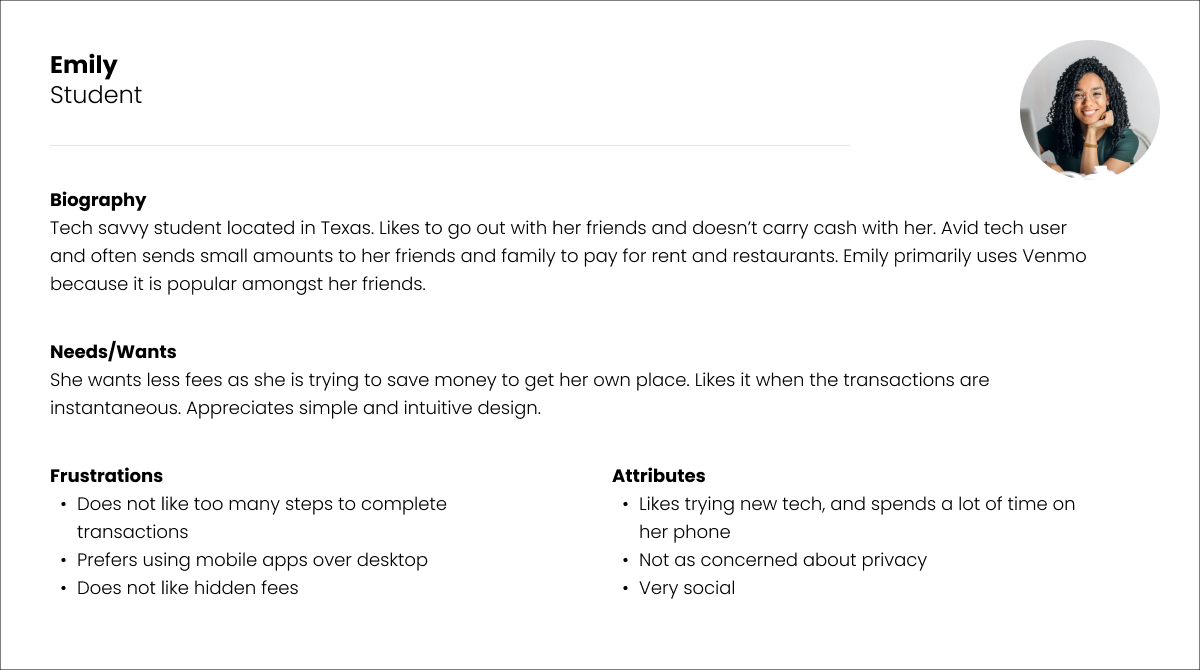
INTERVIEW SUMMARY
The results show that Venmo and Zelle are the most used transfer methods, but users still rely on Wire Transfers for large amounts since the methods above usually have a cap of $5,000 per transaction. PayPal was rarely used, mainly due to its poor customer service and lack of assurance when sending money.
Users like the security associated with wires, especially when transferring money abroad, but did not like the slow transfer speeds since they are often sent out in 1-5 business days. However, most users are fine with the transfer speed and give wires a high degree of confidence. Fees are generally not an issue, either, as long as they are a flat rate and not a percentage-based fee. For transfers to certain countries, users would prefer to use apps like Wave or World Remit as they provide a quicker experience and avoid excessive background checks.
DESIGN PLANNING
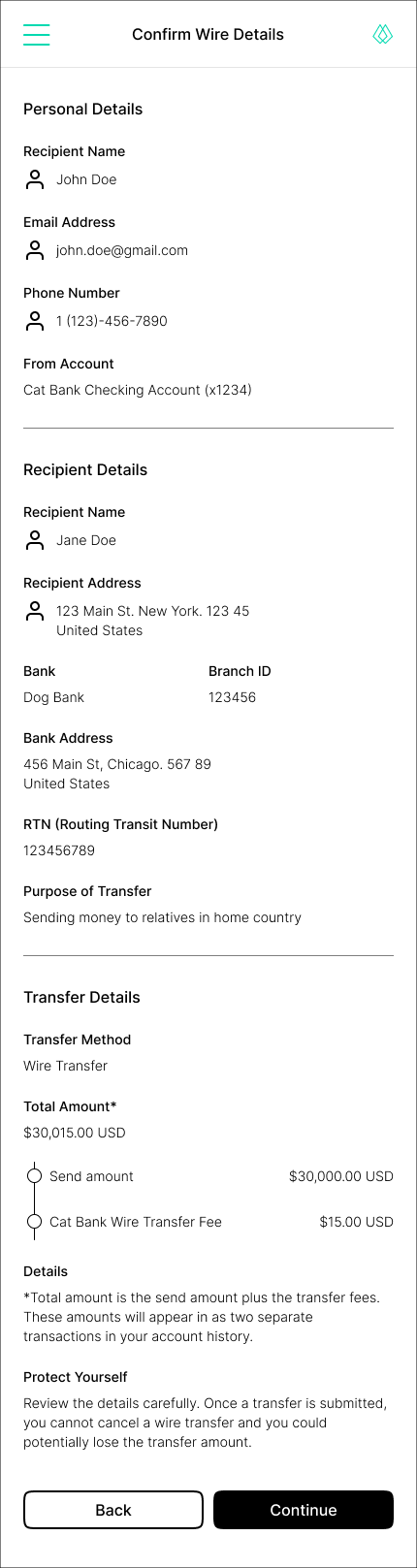
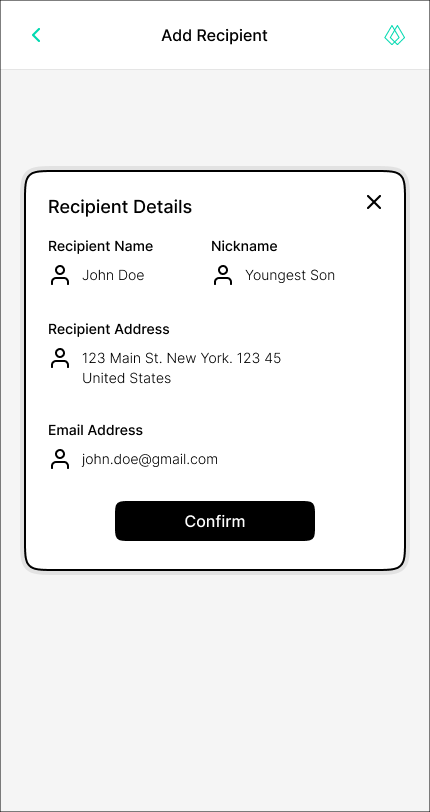
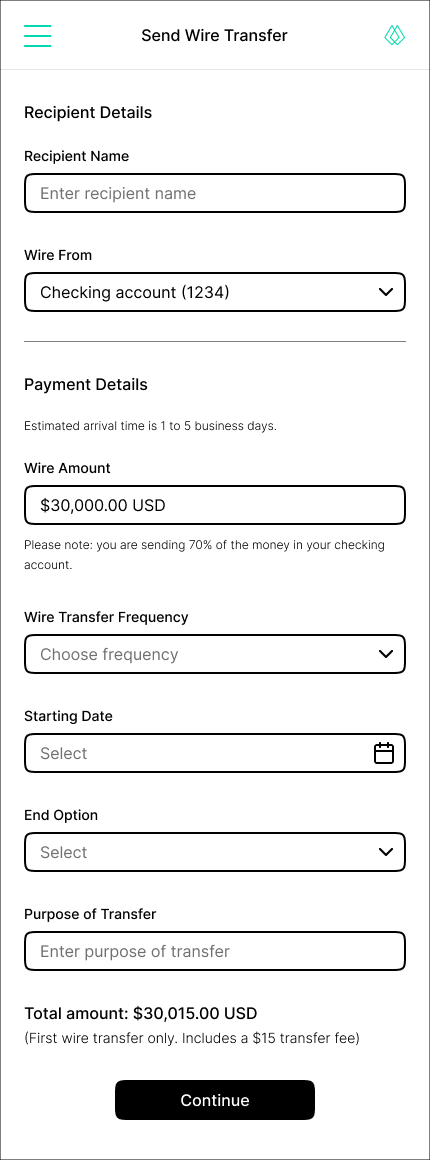
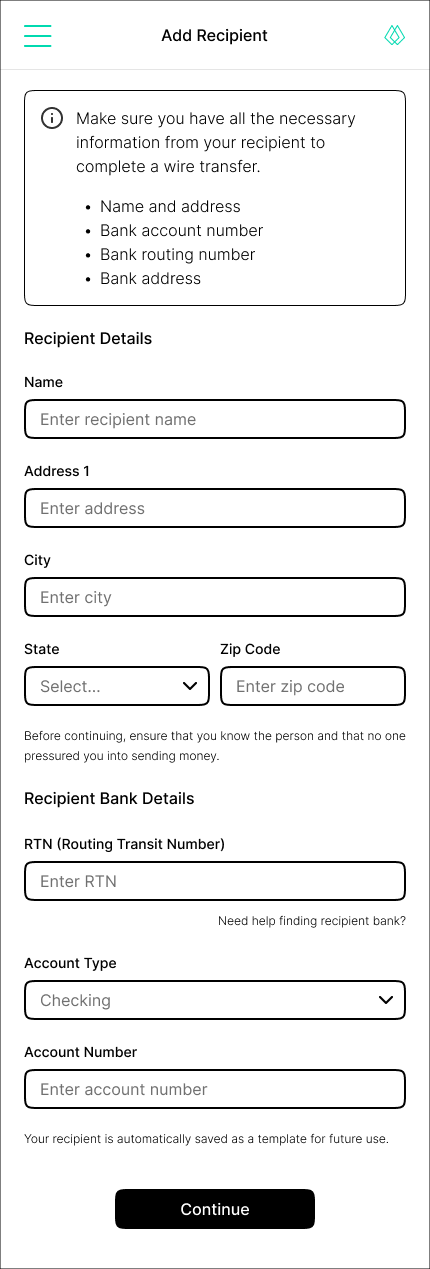
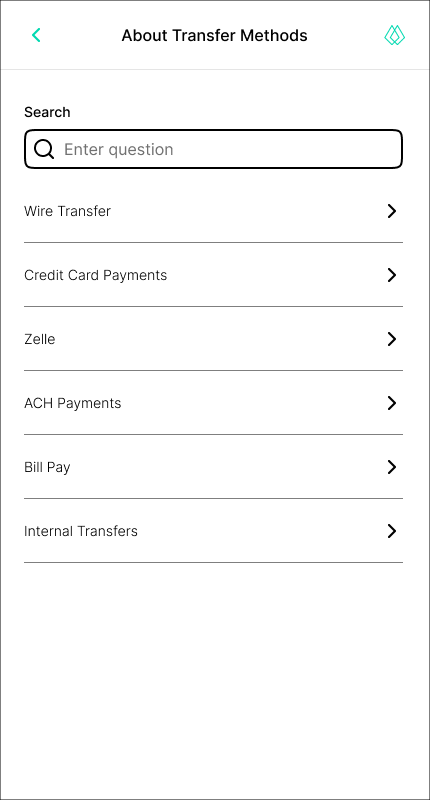
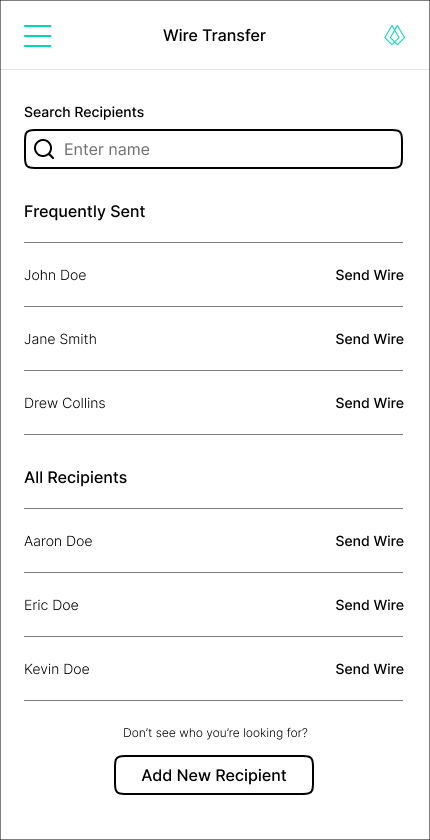
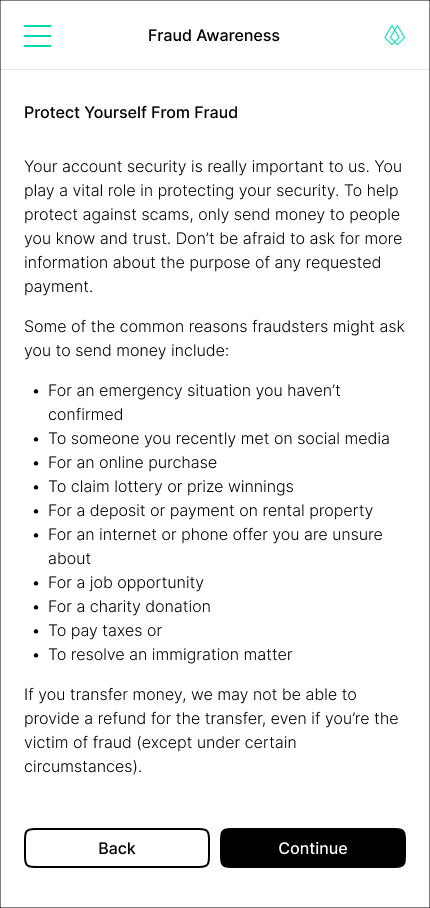
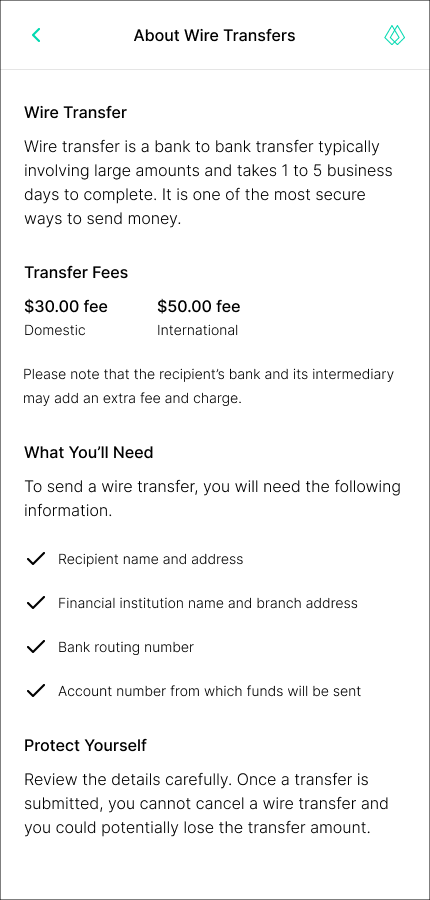
Moving forward, we refined our initial wire transfer flow based on our research. We wanted to know whether these designs would resonate with our users, so we invited back some users to test these updated designs, alongside new ones. The images below are simplified wireframes of the key pages included in the process. For the 2nd round of interviews, users were asked to complete a transfer flow and note their experience along the way.

ROUND 2 INTERVIEW CRITERIA
For the 2nd round of interviews, 10 users participated under the following criteria:
- U.S. residents
- Tabby Bank customers
- Completed a wire transfer in the past 12 months
The primary goal was mainly to see whether the updated designs aligned with the customer's mental model and whether it was intuitive to navigate.
INTERVIEW SUMMARY
In summary, customers said that the design was clear and the information was well summarized. They said that the experience was very straightforward and to the point. They liked that the fees were listed and generally found the information helpful. They also noted that the fraud warnings were excessive, and almost everyone found the recurring transfers function confusing.
For this round, we asked all our users what an ideal scenario would be and received the following:
- I want the experience to be similar to transferring money between accounts, going through immediately, while maintaining security
- Wire transfers should provide feedback when they're completed, with fees outlined clearly
- Security should scale with the amount being sent, and it should be free for certain amounts
What did we learn from this?
The interviews taught me all the things we could do to enhance the experience or to make it as seamless as possible. However, that is also what makes it frustrating. The problems that people had with wire transfers remained; fundamental risk screening, metadata, automation, alongside a whole slew of legal and compliance issues, etc. Looking at a typical use case, there would be almost no reason for users to send wire transfers over other methods like Zelle, Venmo, or e-transfers beyond the imposed amount limit.
To have widespread adoption, banks will need to overcome the barriers that made wire transfers great in the first place.
NEXT STEPS
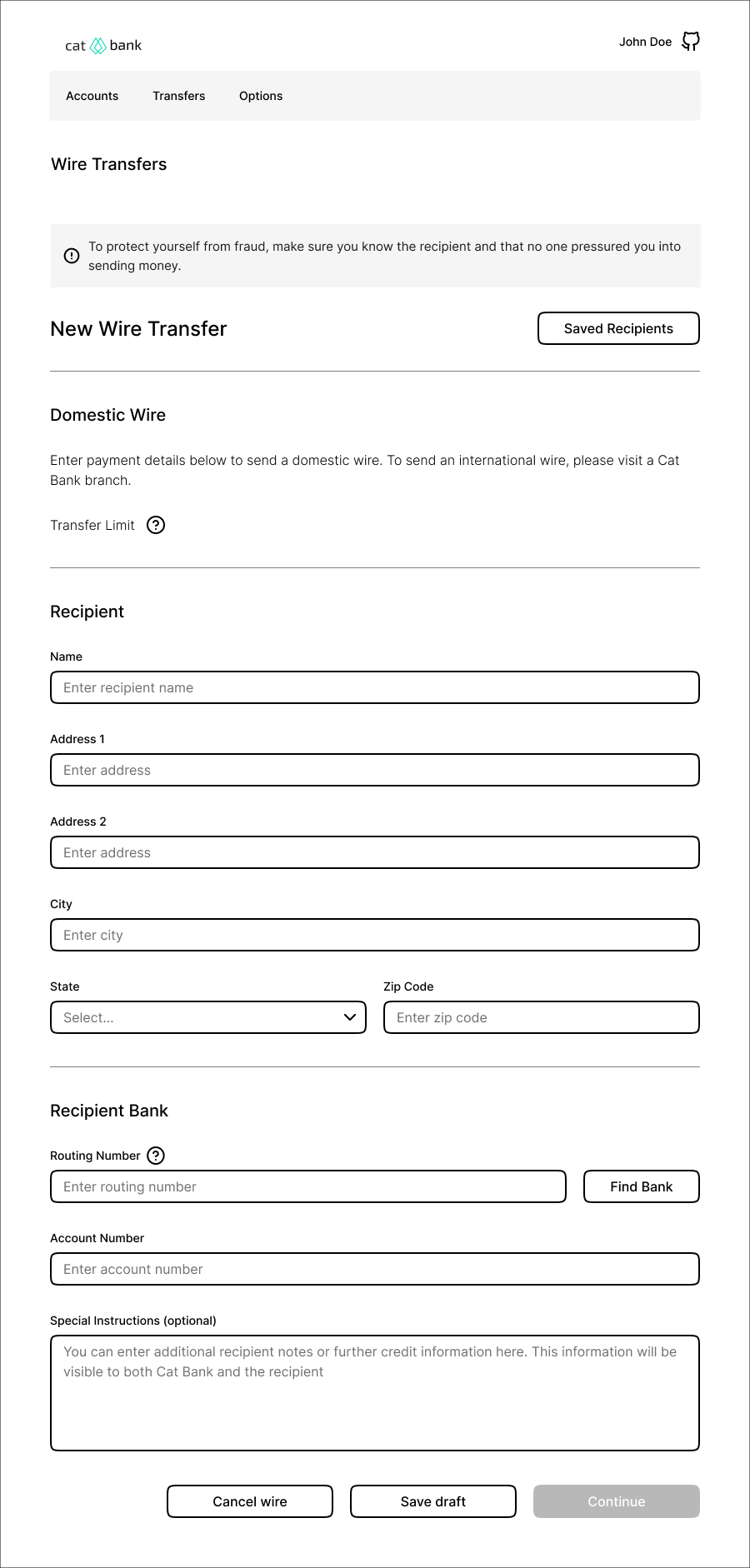
Regardless of the barriers, our roles as designers were not done. Maybe due to the barrier to entry or the history of wire transfers, the majority of our users preferred to conduct wires on a desktop. As such, we were tasked with rebuilding the experience on desktop. This was an opportunity for us to sort out the issues in our previous designs and make use of the differences in platforms to deliver a final, cohesive experience.
Below is a user flow to illustrate how a typical user will send a wire transfer at Tabby Bank. It's an aggregation of everything we learned up to this point.
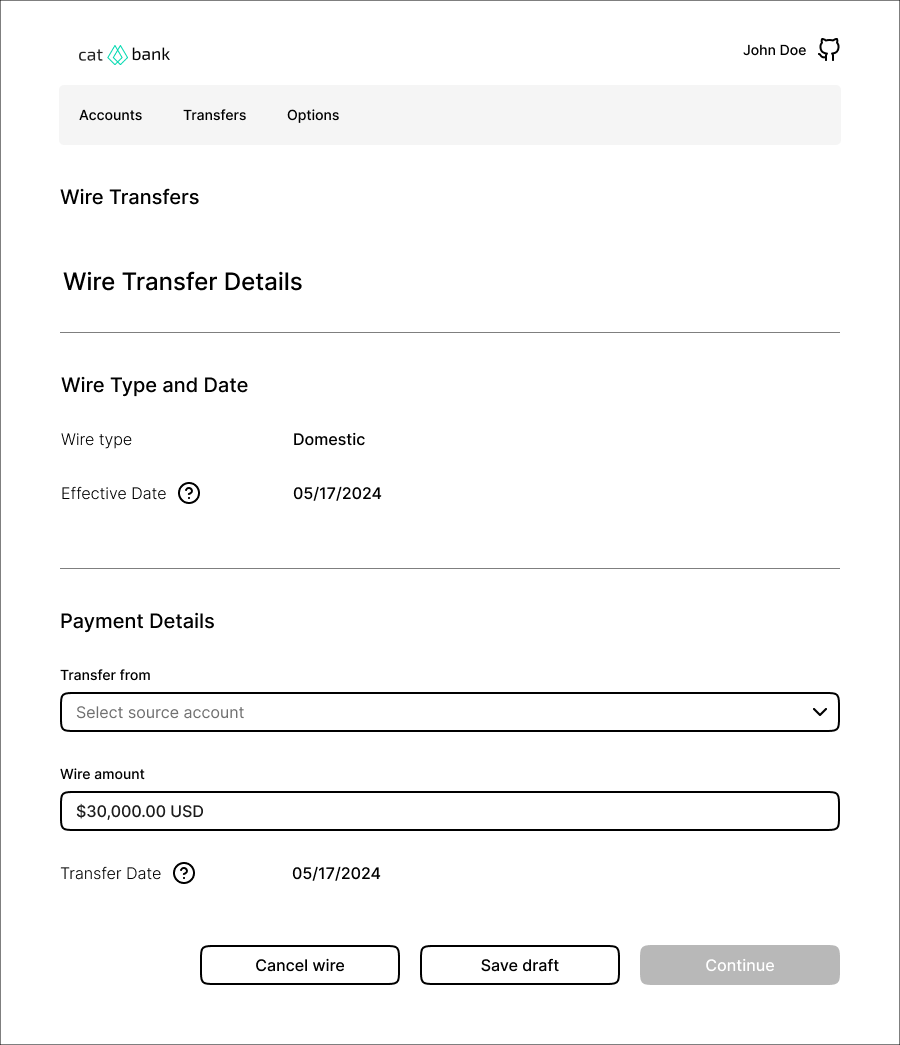
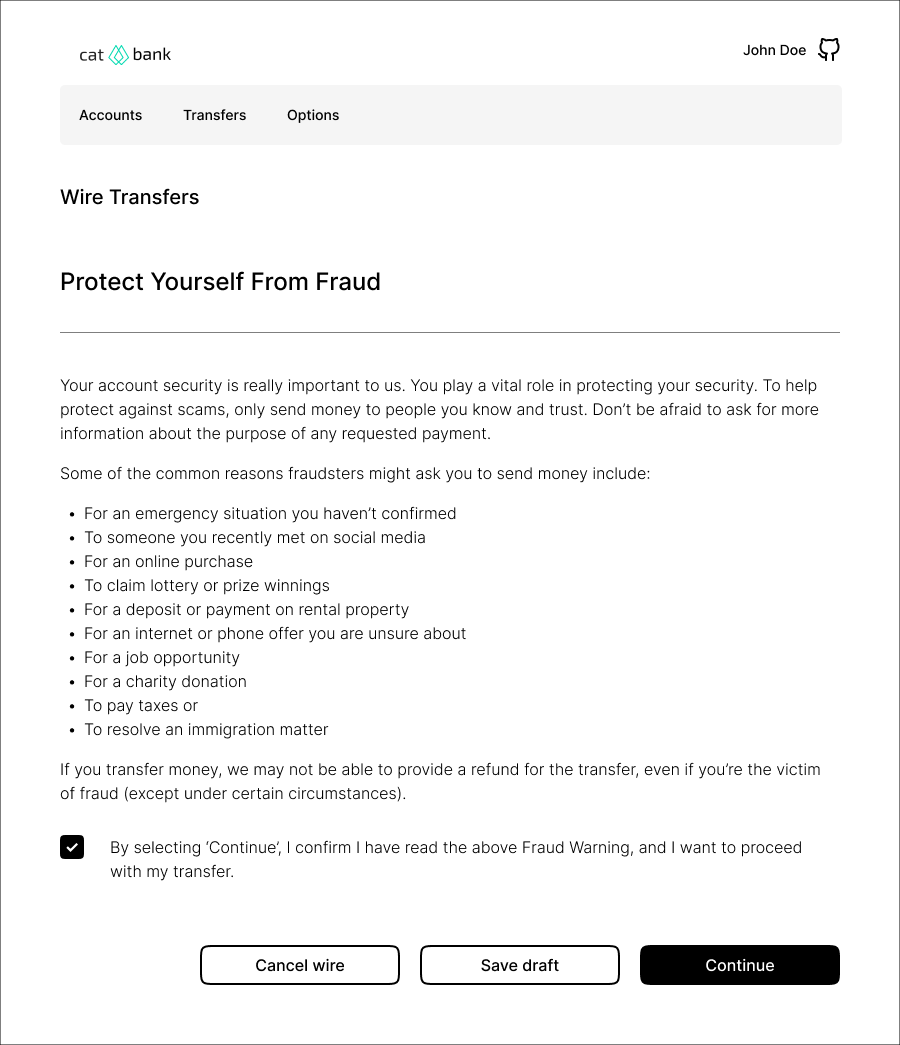
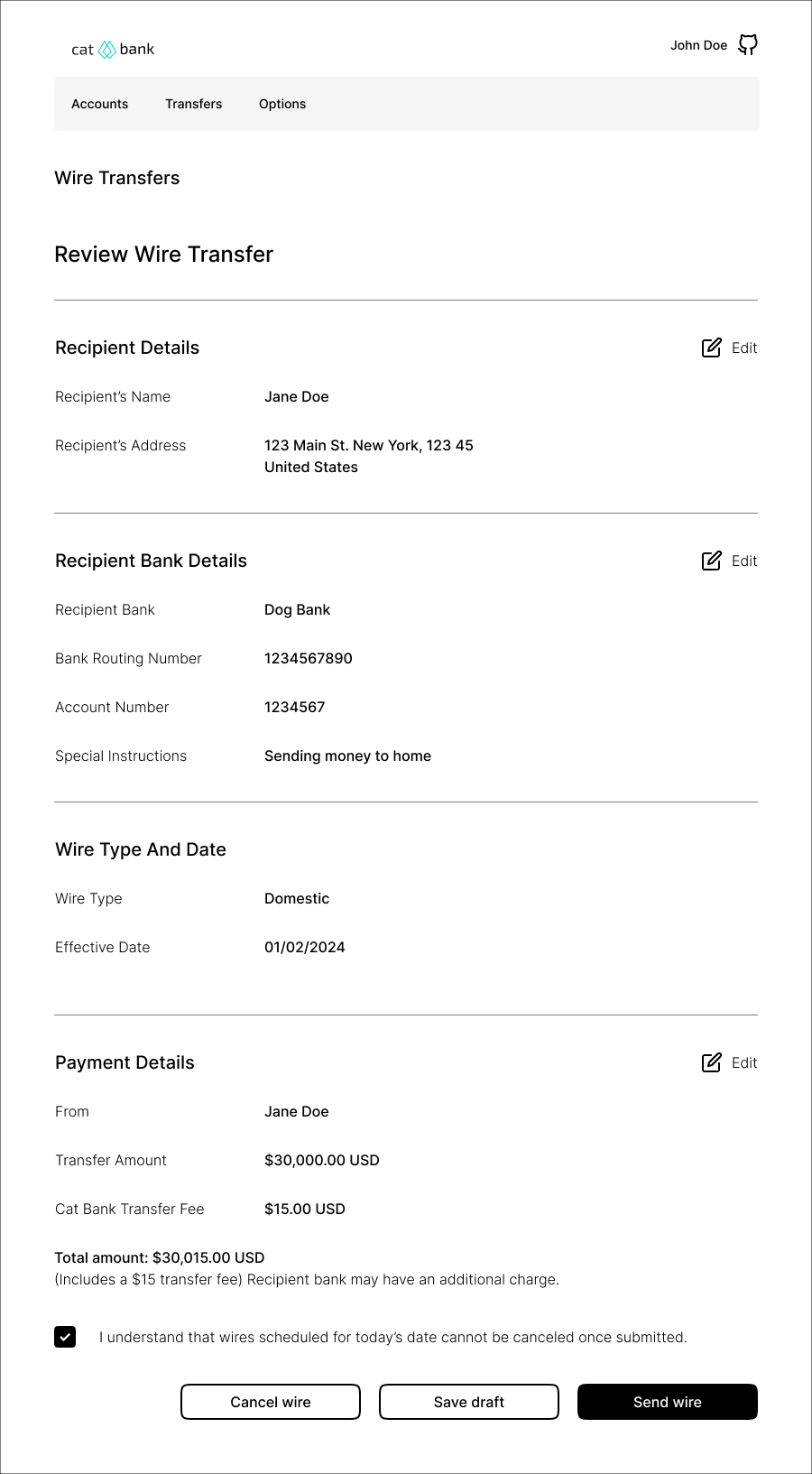

The flow was simplified into five main steps:
- New Recipient
- Wire Transfer Details
- Fraud Awareness
- Review Wire
- Confirmation
This was a long project. To get here, understanding the nuances that make up every part of sending a wire, to minimizing pain points. It felt like we were so close to completion. I would like to highlight some design principles conveyed in the wireframes that may not be immediately apparent to readers.
Working with business, legal, and compliance teams, we tried our best to minimize the recipient information requirements. Asking only for the information we need, as well as providing clarity through confirmation checkpoints. This acted as a guide for those who are new to wire transfers. We tried to outline fees clearly, showing the total send amount, which will always include the fee.
DESIGN PRINCIPLES
Reducing Cognitive Load
Working with business, legal, and compliance teams, we tried our best to minimize the recipient information requirements. Asking only for the information we need, and providing a guide to help users input unfamiliar details like SWIFT codes or routing numbers.
Transparency
Throughout the process, we made the fees transparent. Clearly outlining delivery time, transfer fees, and exchange rates for international transfers before the user commits.
Error Prevention
Validating field inputs in real-time and minimizing errors by ensuring all form formats are valid. This part is critical as a single typo can send money to the wrong recipient.
Confirmation
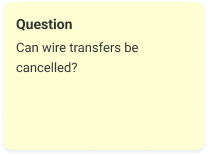
By providing multiple layers of review screens, users can be assured that the information they input is correct and be aware of the consequences of sending a wire. The effective date is shown, and users must confirm that they understand that wires cannot be cancelled. In addition, wires are usually held in place until the end of the day to ensure users can clear up any mistakes before it's final.
Clarity
Making each step feel natural and helpful. Using helper text inside boxes, and anywhere that might not be very clear, while breaking down the process into easily digestible steps.
WHAT WE ACHIEVED
Even though the project was put on pause before final development, the work we completed laid the foundation for a safe and user-centered self-service wire transfer experience.
Through our research and testing, we uncovered critical user needs and pain points by understanding the market and how actual users feel about wire transfers. We successfully mapped out the end-to-end flow and requirements by identifying the data that we need to collect and the necessary compliances. It helped me work extensively with a cross-functional team from UX Researchers, business, legal, and developers, to collectively understand everything that goes into a project of this scale. And though this, we validated the opportunity of self-service wire transfers, which was our goal to begin with.
I hope that I will again be part of the team to complete this project, but even if I am not, the insights and flows we made will lay the foundation of what it might look like for Tabby Bank in the future.
@ Gordon Lam 2025-2026
Let's create meaningful work together. - Glam517@gmail.com